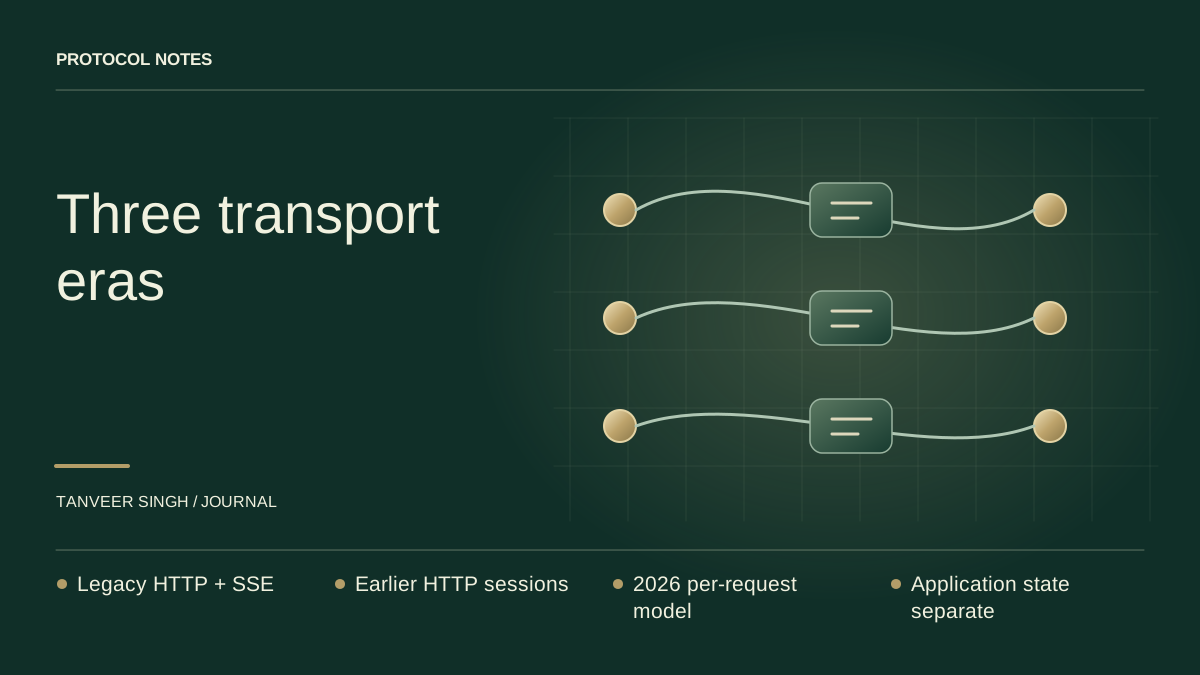
Streamable HTTP and SSE are not complete opposites. Server-Sent Events is a way to carry a stream over HTTP. MCP's Streamable HTTP transport can use a request-scoped SSE response. What changed across MCP versions is how requests, streams and connection state fit together.
SSE is a streaming format, not the whole architecture
This guide is checked against the 2026-07-28 specification. It also discusses older behaviour so you can identify which examples apply to your clients. Before changing a server, write down the protocol revisions and SDK versions you support. “Uses HTTP” is not specific enough to decide whether an example is compatible.
If you remember one point, make it this: an old persistent event-stream transport, an earlier session-based Streamable HTTP server and a current stateless server are three different compatibility situations. Copying setup code across them can produce failures that look like hosting problems but are really protocol mismatches.
Read the version before the tutorial
Earlier MCP HTTP+SSE implementations used a different connection arrangement from Streamable HTTP. Earlier Streamable HTTP revisions could establish connection-scoped sessions using an initialise handshake. The July 2026 revision moved the core protocol to a per-request, stateless model.
The release announcement retires the initialise handshake and Mcp-Session-Id for the new protocol. The current transport overview describes each message arriving by HTTP POST at an MCP endpoint, with a JSON object or request-scoped SSE stream as the reply. Streaming therefore remains possible without reviving the old session model.
Stateless protocol handling does not mean your application must forget a user's workflow. A job, conversation or approval can still have explicitly managed application state. Keep that state distinct from a protocol connection so it survives a function ending or a client reconnecting.
- Legacy HTTP+SSE: identify it explicitly and follow the compatibility guidance for that revision.
- Earlier Streamable HTTP: check whether the implementation expects initialise and connection-scoped sessions.
- 2026-07-28: use the documented per-request metadata and current transport behaviour.
- Application workflow state: persist deliberately; do not confuse it with a transport session.
Migrate one client and one operation first
Start with a read-only tool whose result is easy to verify, such as returning the status of an authorised job. Record a successful request and response in a test environment. Compare the existing client version with the server's intended version before investigating proxies or scaling.
Build the new endpoint using an SDK that documents the protocol revision you need. The official C# SDK describes stateless handling and compatibility modes for older clients. That is useful guidance for a .NET implementation, but the same decision must be made explicitly in any language: current clients only, legacy clients only or a tested mixed environment.
Keep compatibility tests around real client behaviour. A current client should not be forced through an obsolete handshake. A supported legacy client should receive the documented fallback behaviour. An unsupported combination should fail clearly rather than hang while each side waits for a message the other will never send.
Test the HTTP path as well as the tool
A tool can return correct data locally while a deployed stream behaves badly. Test the complete route through your proxy or hosting platform. Confirm whether the response arrives as one JSON object or as a stream, whether intermediaries buffer it and how cancellation behaves when the client disconnects.
For a request-scoped stream, keep useful progress separate from the final result. Do not send an endless stream of decorative updates to hide an operation that cannot complete within the host's limits. If the job genuinely outlives an HTTP request, design a durable job with a status operation rather than hoping the connection remains open.
Record the first-response time, completion time and error category. Log request identifiers and protocol versions without logging secrets or private payloads. These records help distinguish a tool exception, an access denial, an incompatible client and a network timeout.
A migration checklist you can use in review
Do not judge the migration from one happy-path request. Include a denied request, a malformed input, an interrupted stream and a backend failure. Restart a server instance between calls to check that you have not accidentally tied application state to its memory.
If you serve multiple tenants, repeat those checks using different identities. Stateless transport handling does not remove the need to enforce tenant boundaries. Every relevant request must carry or resolve a trusted identity and reach the correct application authorisation checks.
- Document supported protocol revisions and client versions.
- Verify current metadata using your SDK and the pinned specification.
- Remove assumptions that a new client must send the old initialise handshake.
- Test JSON replies and streamed replies through the deployed network path.
- Check cancellation, retries, authentication failures and denied business actions.
- Keep rollback and legacy compatibility decisions explicit.
Questions that cause avoidable confusion
Is SSE removed? No: the current Streamable HTTP binding can still use SSE for a request's streamed response. That does not mean the legacy HTTP+SSE transport remains the preferred architecture for a new implementation.
Can this work on serverless hosting? A stateless request model fits that execution model more naturally than instance-local connection state, but host duration, streaming and resource limits still apply. Test your provider rather than treating “stateless” as a guarantee of unlimited jobs.
Should you delete all session code immediately? Only after identifying which protocol revisions your real clients use. A version-aware migration preserves required compatibility while making the new path clear. Keep the deployment notes dated, because a transport article without a version can become misleading very quickly.