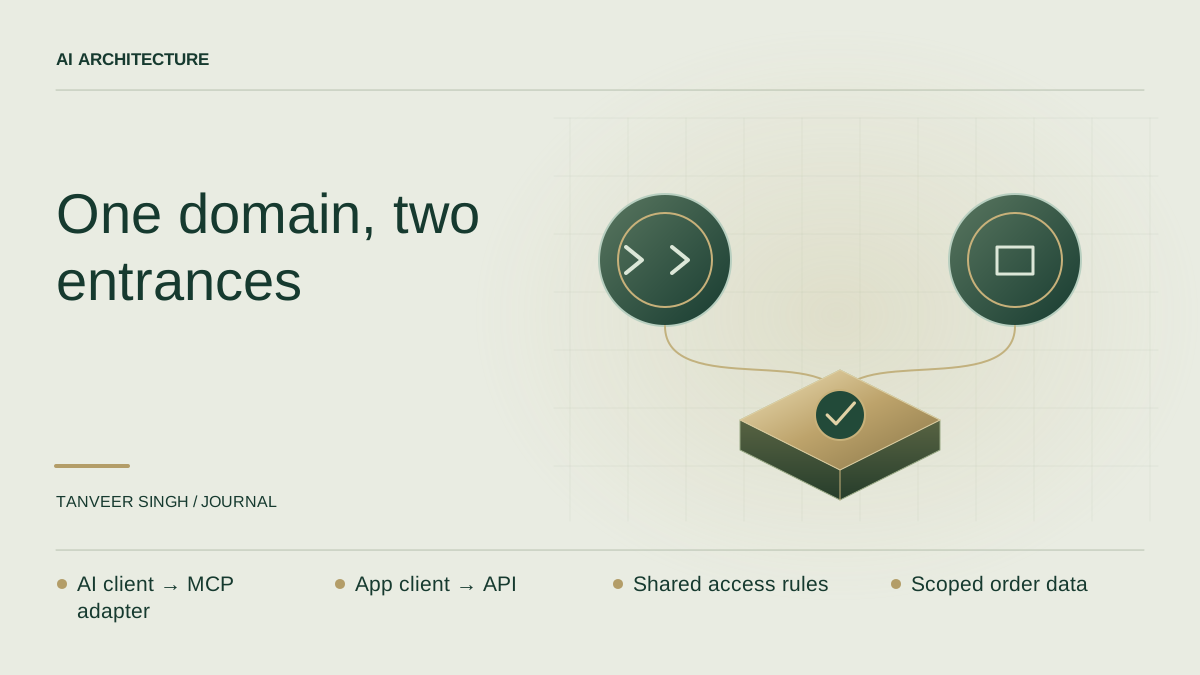
MCP and an API usually solve different parts of an integration. An API exposes application operations to software clients. Model Context Protocol gives compatible AI clients a common interface for discovering and using capabilities such as tools. An MCP server can adapt an existing API rather than replace it.
The short answer
If you are building a single application that calls one known backend, a direct API integration may be the simpler choice. If several compatible AI clients need to discover and use the same carefully scoped operations, an MCP interface can reduce repeated client-specific integration work.
The useful decision is therefore not whether MCP is newer or more “AI-native.” It is whether standardised tool access solves a real interoperability problem in your application. Add the adapter when that problem exists, and keep the business rules in an application layer you can test independently.
An order-status example
Consider a support team that needs an assistant to answer “where is my order?” The existing backend already knows how to find an order, check whether the caller may view it and return a safe status summary. That backend should remain the authority for those rules.
An MCP adapter could expose a tool called get_order_status with a small input schema. The adapter validates the request, attaches the authorised identity and calls the backend. It returns only the fields the assistant needs: a status label, expected next event and approved customer-facing explanation. It need not expose internal notes, supplier contracts or the full customer record.
The tool's input might contain an order reference. It should not let the model supply an arbitrary account ID and thereby choose whose records it can access. The server must derive or verify the access scope using trusted identity, rather than accepting a model's statement that the caller is authorised.
- AI client: decides whether the available tool is relevant to the user's request.
- MCP adapter: presents the tool, validates the input and translates the call.
- Application API: enforces ownership, permissions and business rules.
- Data layer: reads only the records allowed by the application decision.
What MCP standardises—and what you still design
The current MCP specification uses JSON-RPC messages and defines transport bindings. Its July 2026 transport overview describes stdio for client-launched processes and Streamable HTTP for remote requests. Tool interoperability does not imply that every operation is appropriate to expose.
You still choose the tool names, schemas, result sizes, error behaviour and permitted actions. You also choose what an AI client may learn about your system. A tool catalogue containing every internal endpoint may be interoperable while being confusing, expensive to use and risky.
Prefer tools that describe a meaningful user task. “Get the delivery status for an authorised order” is easier to reason about than a generic “run any backend request” tool. Keep output small enough to inspect and structured enough to distinguish an actual status from an explanation of a failure.
Keep authentication and business authorisation separate
Authentication establishes who is calling. Business authorisation decides which records and actions that identity may access. The MCP authorisation specification addresses protocol-level access for protected resources; it does not write your application's order-ownership rules.
For the example, test two different authorised users with similar order references. User A must not see User B's order merely because the tool request is well formed. A successful connection to the MCP server should not be treated as permission to read every tenant's data.
For write operations, decide where approval and duplicate protection belong. A model retrying a request must not issue the same refund twice. The backend should enforce the action's eligibility and idempotency independently of the assistant's instructions. These are application responsibilities whether the caller uses MCP or a direct API.
When a direct API call is enough
Suppose your own web application has one assistant and three fixed backend actions. You control both sides, and no external client needs to discover the tools. A direct integration may be easier to deploy, monitor and debug. You can still use typed schemas, narrow permissions and clear tool descriptions without adding a separate protocol server.
MCP becomes more attractive when you need a shared interface across compatible clients, when tool discovery matters or when an existing platform already supports the protocol. Weigh those benefits against another boundary to secure, version and observe. Interoperability is valuable when it replaces real duplicated work.
Do not migrate every internal service because one assistant needs access to it. Start with a small adapter around a few stable application operations. This lets you test the interface without changing the architecture that already handles your transactions.
A checklist before adding the adapter
List the clients that need access, the operations they need and the records each identity may view. Decide whether discovery is useful or whether a fixed integration is sufficient. Define the error response for a denied request, an unavailable backend and a repeated write.
Pin the protocol and SDK versions in your implementation notes. The July 2026 revision changed connection assumptions, including the move to a stateless core. An old example can be correct for its own version and unsuitable for your deployment. Test the clients you actually support rather than assuming every MCP client uses the latest behaviour.
The cleanest architecture keeps the domain service usable without an AI client. MCP can then become one well-defined entrance to the application instead of the place where its business rules accidentally accumulate.